Q - flow
Measured in liters/minute, m3/hour, or GPM. Higher flow means the pump moves more water volume.
Other products
TrustVolt offers diesel engine water pumps for irrigation, water transfer, drainage, and industrial use. Models are selected by power, flow in liters/minute, head height, pipe diameter, and water type.
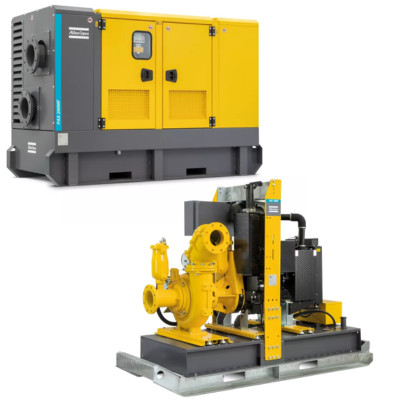
For small irrigation, field water supply, drainage, tanks, and agricultural use with typical flow around 200-1,500 liters/minute.
For farms, construction sites, water transfer, irrigation, wells, and systems needing medium to high flow, usually 1,000-5,000 liters/minute.
For industrial sites, mines, site dewatering, emergency discharge, and intensive irrigation with flow around 4,000-12,000 liters/minute.
For large infrastructure projects, high-volume water transfer, and heavy industrial applications with flow that can exceed 20,000 liters/minute depending on pump and head.
When comparing water pumps, the most important data points are the Q-H curve, flow, total dynamic head, NPSH, efficiency, and pump materials. These show whether a 3 kW, 30 kW, or 400 kW pump is actually suitable for the job.
Measured in liters/minute, m3/hour, or GPM. Higher flow means the pump moves more water volume.
Shows how high or at what pressure the pump pushes water. When H rises, Q usually decreases.
Total Dynamic Head includes vertical lift plus losses from pipe length, bends, valves, and filters.
Checks suction conditions so the pump avoids cavitation, especially with wells, low tanks, or long suction lines.
The pump should run near its high-efficiency duty point to reduce fuel use and mechanical wear.
Clean water, sand, mud, or solids require suitable impellers, pump body, and mechanical seals.
Pumping systems
For agriculture, TrustVolt helps select the pumping system based on water source, irrigated area, required pressure, and flow in liters/minute. The goal is to supply the greenhouse, field, or farm with steady and controlled water delivery.
Pumping systems for greenhouses where steady supply is needed for drip irrigation, sprinklers, filtration, and feeding lines. Selection depends on greenhouse area, required pressure, and the number of zones running at once.
Single-pump or multi-pump stations for fields, greenhouses, orchards, and farms. They can include a main pump, standby pump, control panel, pressure sensor, valves, and distribution manifold.
Drip irrigation usually needs stable pressure and water filtration, while sprinklers need higher flow and pressure. The pump is selected by liters/minute and system head.
Greenhouses and farms can add sand/disc filters, fertilizer dosing, injectors, control valves, and pressure measurement for steady operation.
The control panel can separate irrigation zones with automatic start based on pressure, water level, or schedule. This helps reduce consumption and avoids overloading the pump.
The system can be designed for wells, tanks, canals, lakes, or reservoirs. Suction height, water quality, pipe diameter, and dry-run protection are important.
Q-H performance curves connect flow with system head and help select an efficient duty point.
Hydraulic conditions such as volume flow, delivery head, pipe losses, and NPSH must be considered when selecting a pump.
For drainage or water containing solids, technical catalogues usually require checking liquid type, solids size, and pump materials.
For many sites, the pump alone is not enough. A complete system needs level control, electrical panels, valves, piping, service access, and protection so the pump operates automatically and reliably.
Single-pump or multi-pump solutions for drainage, water supply, stormwater, process water, or transfer from pits and tanks. The station can be fixed, portable, wet-pit, or dry-pit depending on the site.
Pump chambers, tanks, covers, pipe inlets/outlets, ventilation, and service access for lifting the pump out. Sizing depends on peak flow, retention time, and water level.
Panels for automatic start/stop, Hand-Off-Auto control, overload protection, phase loss protection, alarms, level control, and inverter/VFD options when energy saving or pressure control is needed.
Float switches, level probes, pressure switches, pressure transmitters, high-level alarms, and pump alternation logic for two-pump or multi-pump systems.
Guide rails, fixing bases, lifting chains, non-return valves, gate valves, manifolds, couplings, gauges, flexible pipes, and anchoring elements for reliable installation.
Mechanical seals, impellers, bearings, cables, relays, thermal protection, capacitor kits for single-phase motors, and wear parts that reduce downtime.
The same pump can deliver different liters/minute when head height, pipe length, diameter, bends, and water type change. That is why selection should be based on real site data, not only motor power in kW.